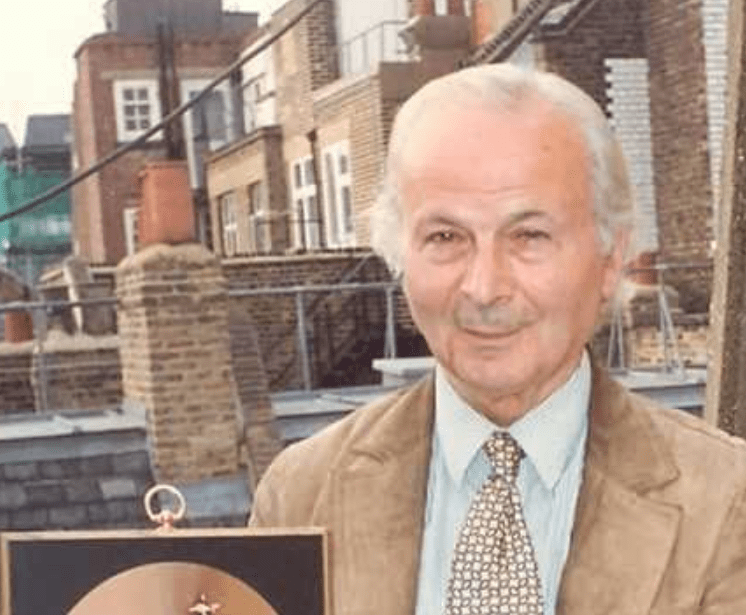
Former Culture Minister of Turkey, a cultural historian, poet and translator Prof. Dr. Talat Halman once observed that Osman Türkay’s work (16 February 1927 – 24 January 2001) combined Blake’s apocalyptic vision which Eliot’s gloomy depictions of modern civilisations. Not only Talat makes this remark but goes further to say that Osman Turkay’s work goes beyond Blake’s and Eliot’s scope, arching over the entire geography of world culture.
Osman Türkay was an internationally acclaimed Turkish Cypriot poet and a writer who was twice a nominee for the Nobel Prize for Literature in 1988 and in 1992. He has been accredited with many awards and honours nationally and internationally for his contribution to literature. Although he was twice nominated for Nobel Prize for Literature, yet anyone who wants to buy a book by him anywhere around the world (except Northern Cyprus) cannot do it. No books by him, bearing in mind he was one of the few poets whose work was translated into many different languages before the world literature discovered Turkish writers and poets the last two decades, can be pursued at any book shop.
It is sad to note that Osman Türkay who created a kind of an ultra-modernist new poetry is on the verge of being forgotten (except in his native country Northern Cyprus).
As someone who has been conducting research on Osman Türkay’s work over the last twelve years, I am still discovering, exploring, uncovering and coming across something new in his poetry and writings. It is like a deep and wide ocean as deeper you dive in, the more you discover. It is an ocean where his thoughts rises like waves of philosophical wisdom.
I walk and how thoughtfully, the places towards times
I stand for a meaning in the abstraction of numbers
Words on tongues, sounds in stars
And a bell rings down the throat of a camel
Words echo, sounds echo, brain echo
As if they collide and crash the mountains in a fight.
His writings are like the eye of his mind intelligently going from one planet to another, to explore the meaning of what is to be being a human on Earth. He describes planet Earth in his poems with a musical rhythm where the soul of Earth, listening to Beethoven, Bach and Mozart.
Convulsion is a pre-Chaotic silenced
Time supervenes: Light.
Mask which descends on a frightful face,
Earth settles: Water
His freezing heart beats in a mountain lake
and in the depth of the sky is Hammerklavier!
His concept of inner-space is composed in his poems as messages. The messages reflect the pictures of his spiritual world. Osman Türkay has seen the universe as part of the creation and focused his theories around cosmogony. His artistic productivity found a base also in his writings where he combined Earth’s past and future as a whole which are intertwined with each other.
We are witnessing the horrific dangers and the destruction of our environment by man-made science. The risks are clearly far too high and the price of human tragedy too heavy and words of the politicians and big business too hollow to be believed.
Türkay was well ahead of his time and the technological progress influenced his poetry. He chose the subjects for his poetry on themes such as nature, environment and the nuclear age. He had seen the destruction of this universe by man-made science which continues its forward march under the veil of progress.
In situations through which all roads lead to destruction
Death loses its natural quality
And fear becomes a blind alley
In the depths of the vast city which we call Universe
Stings its virulent pain into your heart
Poison, the vomit of the cobra,
Like a loose ink pistol
Türkay was a poet of the new space age. His model was the universe and the light is the true meaning of everything in the cosmos and the cosmos the real mother of mankind. He was exploring the meaning and the roots of the universe by underlying the importance of light on Earth. His devotion to mountains, sea and the sky is his affection for nature. Nature nurtured his poetry in his native country Cyprus from an early age as his young adulthood experienced shaped his philosophical writings in his later life.
Your life is fire,
or, it is hissing waters.
Heat is another terminus, outside
the boundaries of numbers:
-Anvil
steel
marblestone
blood.
O Man, come then, be a dagger
and slip out of your sheath;
come, be a sea, a light
or water:
Even the extensive written words are too less to describe Osman Türkay’s poetry. Another year passed without seeing his work been acknowledged or published. It makes me sadder year by year a poet, a writer, who contributed immensely to world literature does not receive the appreciation, which he rightfully deserves. How will the new generations know about this space age-poet, how the world of literature will make progress on the Millennium poet, when nothing by him is published in English, also he is a renowned and celebrated as a Millennium poet?
Türkay was not only a poet but also as a translator who translated into Turkish the works of T. S. Eliot, Ezra Pound, Dylan Thomas, Pablo Neruda and Vladimir Mayakovski. How his work can go unnoticed by the authorities on literature in Turkey is beyond anyone’s imagination.
His humanism, his abstract formulation of the Universe, the cultural references in his poem and the various different themes of his poetry should not be kept to the old publications of his books but should be shared with the 21st Century general public to enjoy and read. That was the reason why his work was published into more than twenty world languages more than a decade ago.
At a distance far away
the aching soul of a pigeon
veils the universal human conditions.
 Semra Eren-Nijhar