When I heard about the Chagall exhibition, I put in my diary as a “must visit” to Liverpool Tate, Merseyside, England.
After much deliberation on whether to make it a day trip, or a trip with a night stop over, I found myself staying in one of the 160 years old city buildings, fabousley converted into a modern hotel, at the heart of Liverpool centre. This building is true example of how conservation is preserving country’s heritage and how the area is being regenerated into compatible modern uses in the heart of the city.
As far as I can remember, I always had a passion for Chagall’s paintings and especially their deep rich colours which capture and fill a person’s eyes, whilst gazing at his dreamlike works.
It was this fascination and love affair with Chagall’s art, that I chose for my brother and sister-in-law‘s wedding invitation card from one of Chagall’s many paintings, ‘flying bride hand in hand with the groom’ over 20 years ago now.
Now finding myself for the first time, in front of Chagall’s original paintings, I’m captivated by the effect of his art and found myself immersed into a beautiful world of poetry, music, dance and literature.
The paintings captured me with their dreamlike floating subjects and their visual depictions. I discovered the notion even more by recognising that Chagall worked intimately with the themes such as homeland, heritage and identity which are close to my own subject areas of research on belonging, history and migration.
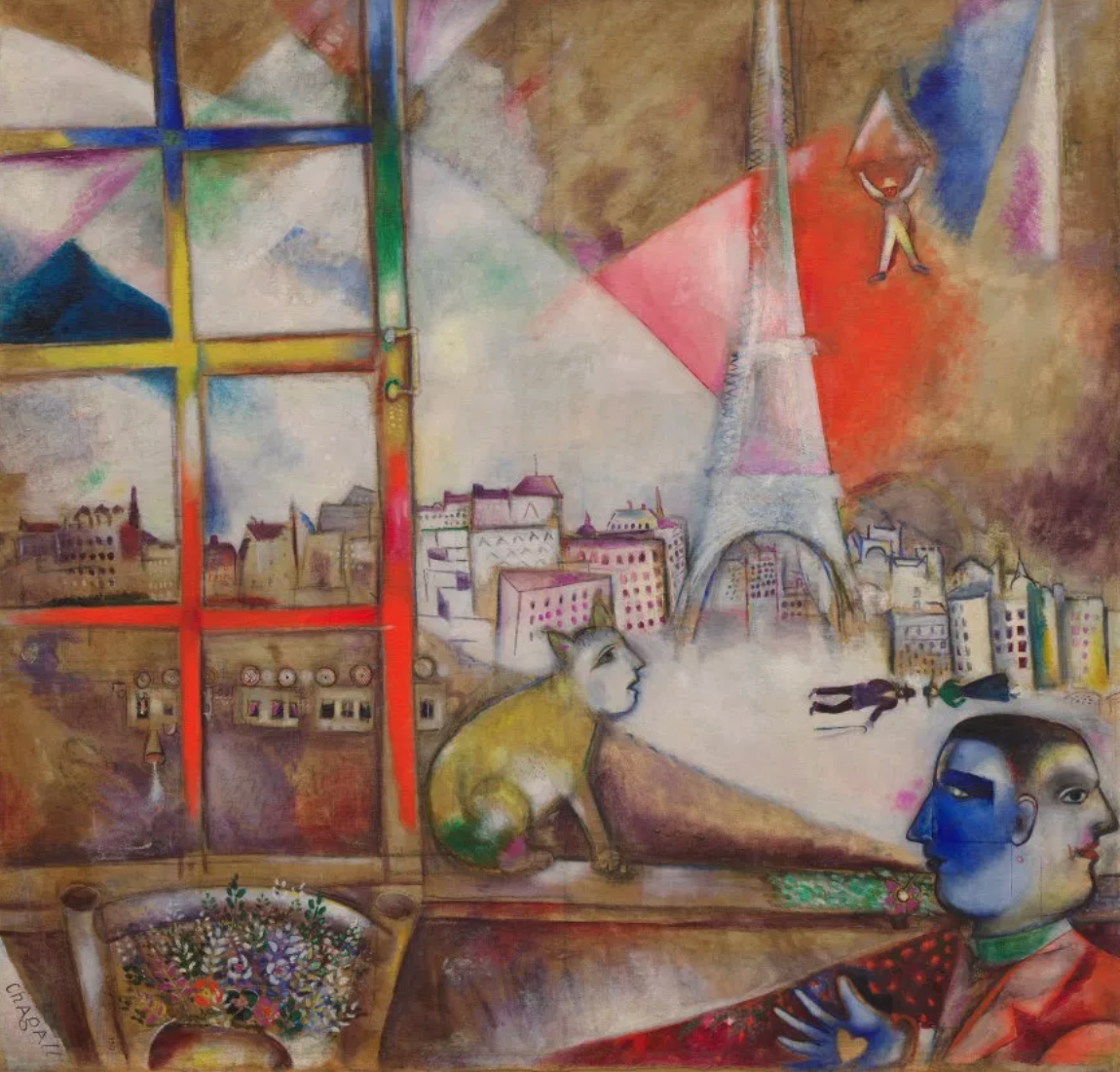
The painting “Paris through the window” which he painted in 1913, is one of the best examples of this, as he tries to take us on a voyage through the painting, to his divided loyalties, between his love of Paris in the West and the nostalgia for his homeland in the East, Vitebsk (Belarus).
The painted figure of a human head at the bottom right hand corner of the painting is facing both ways, and looks in two different directions. It makes a strong statement on the notion of belonging to two different countries, regardless of neglecting one over another; a very simple yet surreal way of explaining the complexity of belonging.
When standing in front of and looking at Chagall’s paintings, it dawned on me, suddenly; gravity which had pulled me towards his art over the past years and decades. Now I fully understand why I was sub unconsciously drawn into the rich world of his colours without even studying his art in depth. It is the notion of the identification of myself within his art and finding myself unconsciously surrounded with these mutual subjects of interest, in his paintings.
Chagall constantly thought around the notion of his Russian-Jewish background, his love and understanding of Parisian art and culture. All these run into each other and influenced his work throughout his life. He’s questioning of the subject of ‘belonging’ became a very permanent theme in his art.
The work “The soldier drinks” which was painted in 1912 confirms conclusively my understanding (or shall I say identification) with his art, as in this painting, Chagall suggests a transition between reality, memory, past and present. The soldier sits in front of a huge samovar. The samovar is also close to my own heritage, and represents tea. Tea is in my memory, in my past, in my present and undoubtedly will be in my future, too. It is something in which I feel very familiar and warm and which gives me a sense of belonging to a culture to which I am strongly attached.
Chagall’s passion for the theatre and poetry transforms into life, as if by magic, in his paintings. His works titled “Music”, “Dance”, “Drama” and “Literature” all painted in 1920 shows a light into his lifelong love for these subjects. In the painting “Homage to Apollinaire”, poetry comes to life where ‘love’ dominates the painting. Once again, Chagall tries to draw his art based upon many cultures. No doubt Chagall’s poetic inspiration led him to create many more paintings around the subject.
One of the most beautiful paintings is “Half Past Three (The Poet)” from 1911. Only one, who understands the soul of a poet can put the verses into colour on a canvas as Chagall did. I stood for a very long time, in front of this painting, which impressed me with its composition. A composition, which created in my head the musical notes of the poetry he brought to life through his deep meaningful use of colours. Nature was very close to his heart as he surrounded the poet with nature. “The poet reclining” painted in 1915 is clearly the mirror of his soul for poetry. Otherwise a soul without the imaginary love for dance, drama, music and literature would not have been able to bring such passionate art to life.
I now know more about Chagall’s art, and more in-depth about his folkloric, traditional, real, surreal, naturalistic, symbolic, cubist and modernist avant-garde paintings. Now I find myself more drawn into his world and his art. And the more I read and learn, the more I get fascinated, how he combined magically the subject such as ‘belonging’ with his brush into a visual tale of colours, and most importantly which enters unconsciously into our memory and leaves its indelible pigment until one day, suddenly, it illuminates our minds with its glimpses, without notice.
As Chagall said, perhaps the only recipe for all his creativity is love: “I love Love. What else should I have depicted if not love and our destiny? Love helps me find the colour for me: I only have to apply it to the canvas. It is stronger than I am and it comes from the soul. That is how I see life.”
31.8.2013
Copyright Semra Eren Nijhar – All rights reserved
 Semra Eren-Nijhar