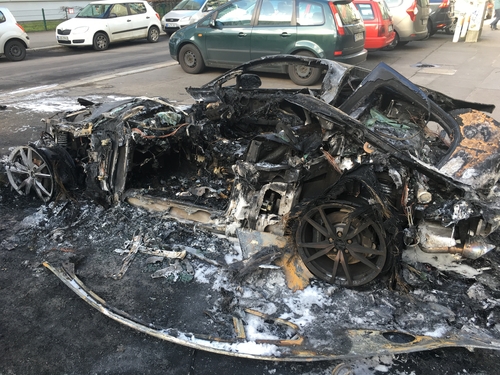
As the whole world had its eye on the troubles in London during the summer, Berlin has been overtaken by a strange wave of car-burning which has gone on for the last couple of years.
More than 370 cars have been set alight in the city, alone this year and 401 cars were set alight in 2009. Everyone in the city has their own opinion about the car burning but this year 155 cases of car burning were being treated as “politically motivated” crimes. Most of the fires take place at night, all but ensuring that perpetrators get away without fear of being caught.
The borough of Friedrichshain-Kreuzberg, which is historically a stronghold of the city’s angry left, is no longer the area where the Authorities concentrate to find the cause for the destruction as the crimes are spreading from Berlin’s poor-but-trendy neighbourhoods to the city’s more affluent neighbourhoods.
The issue became a hot political campaigning topic for the city and state elections which took place in September. Even the Chancellor has become involved, saying she is watching developments “with great concern”. As the result of the elections has indicated what controversially perhaps one of the politician from Angela Merkel’s Christian Democratic Union party had floated the idea of Berliners forming a Bürgerwehr, a kind of unarmed citizens’ militia. The Piraten Party surprisingly won a good number of votes in which the Party tries to become the voice for the new changes.
Burkard Dregger didn’t come up with the Party’s triumph in September as he told the voters that he will kit out 1,000 volunteers with truncheons and handcuffs.
But of course the idea was immediately challanged by the Germany’s police union “Bounty hunters belong in westerns,” when the representative Klaus Eisenreich told the newspaper Die Welt that, “Vigilante justice is a real risk. Solving the crime of car burning is a job for the police.”
And it is for the Police as we have seen with the events in England. In fact the troubles demonstrate a good example in which the Police can play in those events a big role and what can go wrong if the police suddenly can’t get organised or stand back and watch as spectators.
Germany is facing nationwide unemployment of around 7 percent while Berlin deals with nearly double that figure at 13.5 percent.
Uwe Frers, who runs a website, says,” Berlin neighbourhoods have been transformed in recent years as wealthy people move into areas that used to have high unemployment, and low housing and living costs. Its inhabitants don’t like their rich neighbours, so they set their cars on fire.”
But according to the German sociologist Klaus Hurrelmann at the University of Bielefeld, the vandalism has found its way into modern culture and says,”The motivation for the attacks has changed over time and the attacks now are dominated by youngsters who are searching for the London kick. Setting cars on fire is cheap and easy.”
The city’s police force has escalated patrols and added helicopter surveillance as Authorities claim that many of those incidents have been politically motivated, with the arsonists leaving notes at the scene of the destruction.
But of course with over 3,000 miles of city streets to cover, the Police department can’t be everywhere at once and the images of the London riots are still fresh in everyone’s mind. And as the memories of recent uprisings in Spain and Greece are still haunting the European politicians, the battle for the city’s soul is not an easy one.
Well here is the news: Unfortunately Berlin is not the only city facing the problem. Cars were set alight in Dusseldorf and Hamburg too.
In Berlin there is a lot to do to for the newly re-elected Social Democrat Berlin Mayor Klaus Wowereit, but as a general problem politicians have to make new plans on how to tackle these issues which have the potential and momentum to become a major a headache for the economic rich Germany.
Copyright Semra Eren Nijhar – All rights reserved
 Semra Eren-Nijhar